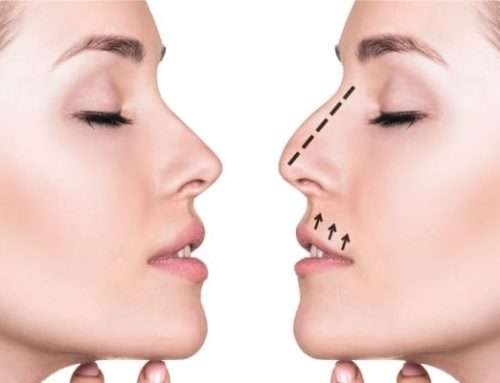
Revision Septorhinoplasty
A symmetrical face and a harmonious nose are considered the building blocks of beauty. In particular, the nose, in terms of its shape and structure, is one of the most important organs that make up this golden ratio. The common dream of many men and women is to have a beautiful and attractive looking face. However, a nose with congenital deformity or deformation as a result of an accident can cast a shadow over this dream.
Today, the number of patients who apply to plastic surgery in order to feel comfortable in terms of aesthetics and to be happier when looking in the mirror is undeniable. Of course, even if they have undergone plastic surgery, there may be people who have intranasal problems, deformities and continuing aesthetic concerns. This is where revision rhinoplasty, or correction surgery, comes into play.
Revision Rhinoplasty
Revision rhinoplasty is an operation applied to patients who have undergone plastic surgery but complain about their nose structurally and functionally. In addition to physical problems, it is often observed that many people with aesthetics do not have a healthy respiration. In nasal surgeries, it is easier to intervene in the anatomical structure, but it may be more difficult to know the condition of the intranasal tissues. For this reason, surgical interventions to be performed for the first time are very important. Aesthetic nose surgeries should be planned with the patient under the control of a specialist physician. Patients who will have revision nose surgery need to be more careful. A second operation to be performed in non-specialized hands may result in irreparable results.
When should patients undergo revision surgery?
First of all, patients should not act too hastily for revision surgeries. Swelling and bruises on the face after the first aesthetic operation may prevent the new shape of the nose from being seen. In order for the arrangement made on the nose to settle, a period of 6 months to 1 year must pass. Afterwards, if there is still concern about the nose, a specialist can be consulted. It should be noted that the success rate of any intervention before this period will be low. In addition, many patients think that the desired shape can be given to the nose in revision surgeries. Contrary to what is known, revision rhinoplasty can only be corrected over the shaping done in the first surgical intervention.
In revision nose surgeries, corrections can be made for the low and upturned nose. In addition, interventions are possible for under- or over-received nasal dorsum. Revision surgeries are not a simple surgical intervention. Because after previous operations, changes in the cartilage or bone structure may have occurred at the support point of the patient’s nose. In such cases, the specialist may need new cartilage grafts to reshape the nose. Revision can be performed by removing cartilage from the ear, ribs or other parts of the body. Instead of these, alloplastic (artificial) materials are rarely preferred.
Techniques used
Two different techniques are used in revision rhinoplasty. If the patient’s nose is damaged and the correction is excessive, the open technique is applied, and if there are problems only on the back of the nose, the closed technique is applied. Whether the open or closed method is used in revision surgeries, the main purpose is to correct the nose without leaving it unnaturally and to eliminate intranasal or breathing problems if there are any. As in all aesthetic surgeries, satisfactory results can only be obtained in revision rhinoplasty with the intervention of a specialist and experienced physician.